Discovering the Historic Vineyards of the Colli Orientali del Friuli

Data:

Posizione:
A Viticultural Sanctuary Beneath the Julian Prealps: The Echo of Time in Ancient Vines
We stand at the foot of the Julian Prealps, far removed from urban clamour and industrial sprawl. Draped across gentle hillside slopes and the upper edges of the alluvial plain, the vineyards guide this viticultural pilgrimage through the northernmost reach of the Colli Orientali del Friuli appellation. Here, time appears to have resisted the relentless pace of modern development, and the vines wear their advanced age with quiet dignity. Many of these plantings have been meticulously tended for fifty or sixty years, and it is not uncommon to encounter specimens approaching a full century of life.
My route traces the vineyards flanking the Strada Regionale 356, the foothill road linking Cividale del Friuli to Tarcento. Near the hamlet of Casali Bertossi, I follow the gentle curve of an old lane threading directly through rows of deeply weathered vines. Drawn by instinct, I leave the car behind and step out into the spring air of an authentic landscape of viticultural antiquity.
The Breath of Old Rows: A Profound Bond Between Land, Grower and Tradition
Walking among these vines, one senses an atmosphere of quiet reverence—a silent testimony to a bygone agrarian era. The wide spacing between the rows still reflects an age when viticulture was integrated with cereal cultivation and forage crops for livestock, embodying a self-sustaining, closed-loop mixed farming system (coltura promiscua).
Here, on the threshold of the mountains, crisp katabatic breezes descend from the valleys in the late afternoon, while at first light a gentle thermal current carries the distant breath of the Adriatic Sea across the canopy. These are long-lived vines that have weathered the tide of modern oenological fashions, remaining faithful custodians of ancestral wisdom and the intimate bond between local growers and their land. Having never chased the fleeting rewards of recent commercial trends, their true distinction lies in having escaped intensive, high-yield viticulture driven by short-term profit. Planted in the last century with indigenous cultivars, they preserve agronomic practices and training methods unchanged for decades—the expression of a slow, observant viticulture rooted in dialogue between vine and soil.
Homage to Refosco di Faedis and the Harmony of the Historic Vineyard
At the foot of the Collevillano hill stands a modest timber shelter erected by the Associazione Volontaria fra i Viticoltori del Refosco di Faedis, complete with interpretive panels celebrating the singular heritage of Faedis’s historic vineyards. Just a few metres beyond lies the Zani vineyard. Strikingly, the younger parcels flanking it do not mar the beauty of the ancient plot; rather, they frame it in a seamless, respectful continuum across generations.
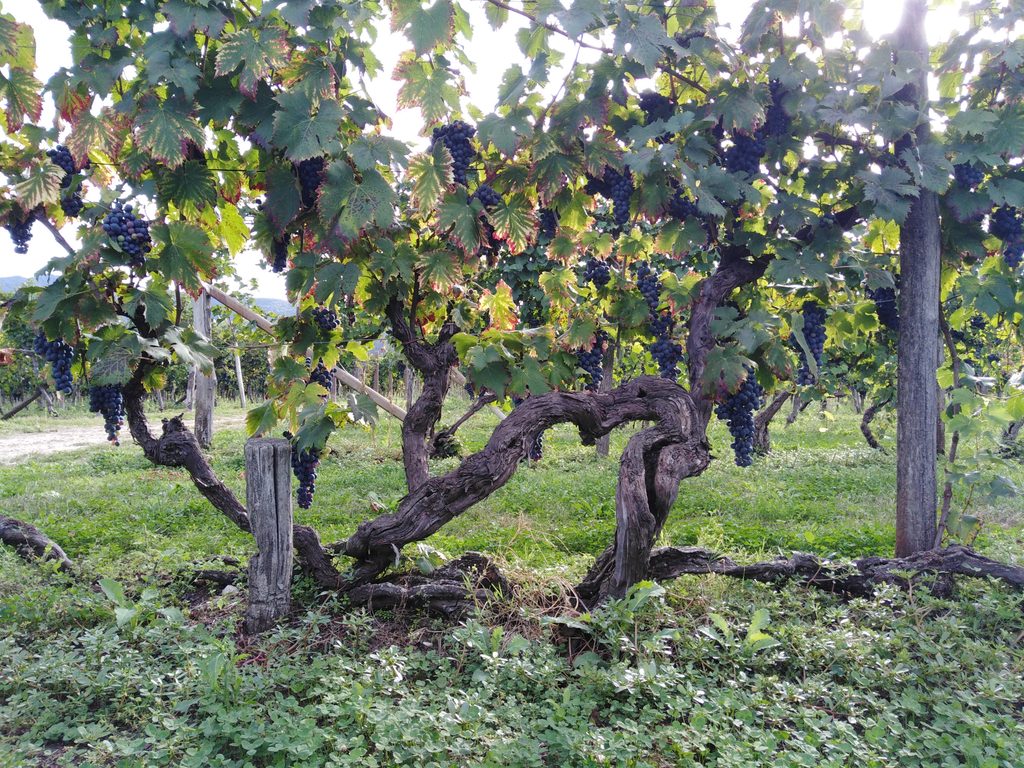
There is a quiet thrill in running a hand over the gnarled trunks of the oldest vines—living green monuments steeped in history—and sensing the centenary soul of the rows. Walking down a parcel planted in 1896, one encounters vines sculpted by time and by the skilled hands that, generation after generation for more than a century, have kept them vibrant, balanced and productive. For a fleeting moment, one almost hears the voices and sees the gestures of the growers who bequeathed these natural monuments to the present day.
Each plant is an individual, irreplaceable specimen. Every trunk tells not only an ampelographic story, but one of remarkable physiological resilience against trunk diseases and pathogens that would decimate a modern commercial vineyard within a few years. Many rise like ancient candelabra, renewing their vitality from the base through layering (propaggine), a traditional propagation technique that ensures both genetic continuity and extraordinary longevity.
A Mosaic of Cultivars: Tales of Vines, Emigrants and a Unique Genetic Patrimony
Within a single parcel, one can discern a kaleidoscope of varieties, distinct in berry colour, growth habit, bunch architecture and leaf morphology. While several have been formally identified through rigorous DNA profiling and ampelographic research, others remain absent from official catalogues, bearing affectionate vernacular names bestowed by their owners—testament to an almost familial bond with individual plants.
Local oral history illuminates the origins of this extraordinary genetic diversity. Between the late 19th and early 20th centuries, this region experienced waves of seasonal winter emigration towards France, Germany and Hungary, timed to coincide with the dormant period in the fields. Returning each spring, these migrant workers carried dozens of scion cuttings (marze) tucked into their satchels from vineyards beyond the Alps, field-grafting them into missing vine spaces (fallanze) back home and inadvertently creating living, multi-varietal field blends.
Roman Legacy and Territorial Identity: When Wine Spoke of Place
These interplanted rows of diverse varieties perpetuate a cultural tradition stretching back directly to Roman viticulture. In the treatises of Columella, Pliny the Elder and Varro, the primacy of provenance—the precursor to modern terroir—was already clearly articulated. A wine’s quality and singular identity were defined not by varietal name, but by the specific site where the grapes were grown. Red varieties were harvested and co-fermented together, just as white varieties were vinified as a unified field blend.
Until only a few decades ago, these hills still produced Nostran Ros and Nostran Blanc—vernacular wines whose very names affirmed their local origin as their defining hallmark. Certain hillside enclaves achieved such renown for the distinction of their wines that the place name itself became a guarantee of prestige, irrespective of the exact varietal composition: Faedis, Nimis and Savorgnano stood foremost among them.
An Invitation to Authentic Terroir: A Sensory Journey in Eastern Friuli
Should anyone still question the true meaning of terroir, they need only walk the vineyards and step inside the cellars of this eastern corner of Friuli. Here are plots tended continuously for nearly a century, often by a single family; centenary vines forged in intimate alliance with the local microclimate, their root systems anchored deeply in the geological and biological fabric of the ponca (Eocene marl and sandstone) and alluvial soils. In the cellar, they yield artisanal wines free from artifice, fermented with indigenous yeasts and guided by quiet, generational intuition.
A Taste of Abundance: The True Soul of Wine Across History, Passion and Biodiversity
This brief excursion through the historic vineyards of the Friulian foothills offers merely a glimpse of the oenological, human and cultural wealth preserved here across centuries. The stories murmured by growers among ancient rows, the palpable dedication of these guardians of biodiversity and the unmistakable signature of a terroir shaped by time cannot fail to stir a deeper curiosity. All that remains is to set out on foot alongside the vignerons, cross the thresholds of their cellars and immerse oneself in the living heritage of the Colli Orientali del Friuli. Buon viaggio, and buon terroir.
Lascia un commento